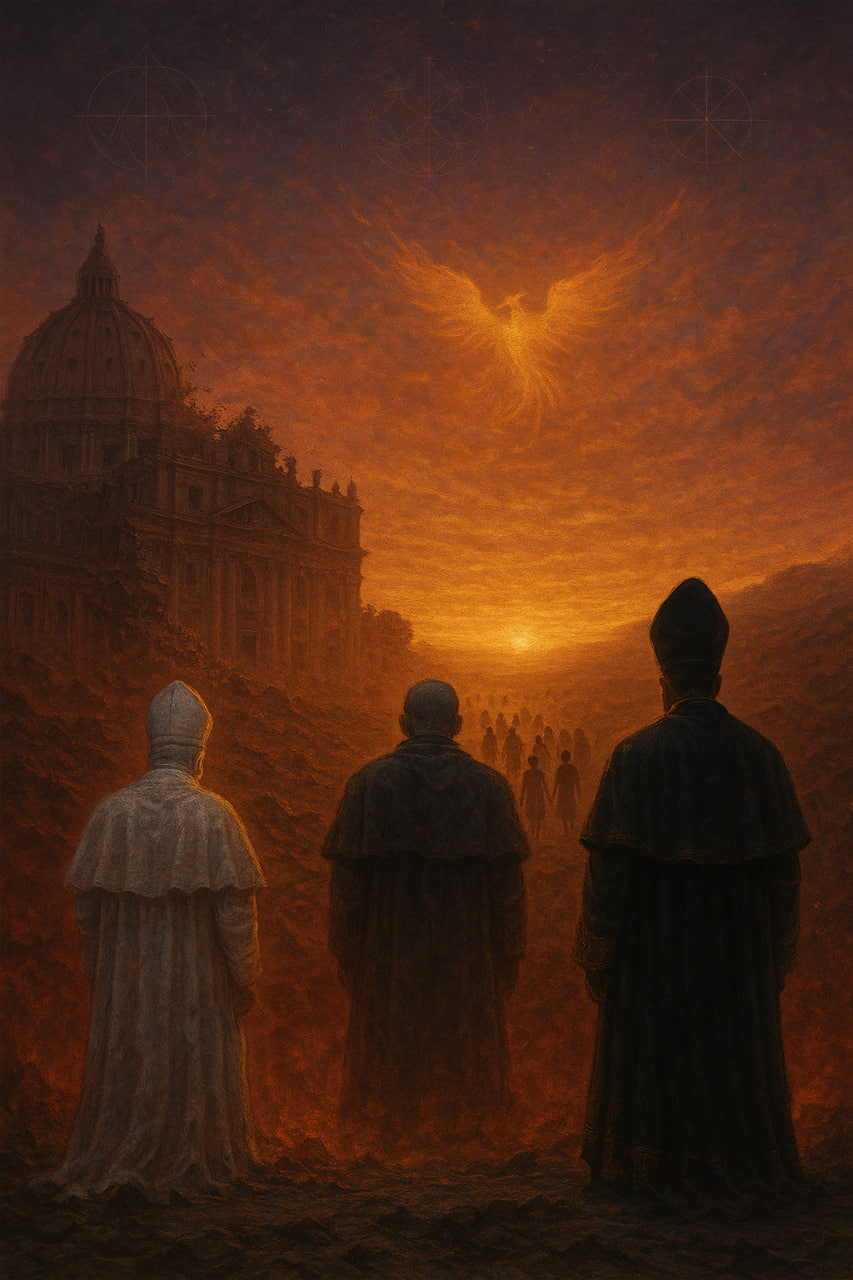
VATICAN CITY — As the veil begins to lift on global power structures, few institutions stand as tall — or as vulnerable — as the Vatican. Once the spiritual anchor of Western civilization, it now finds itself entangled in prophecy, scandal, and symbolic disintegration.
With the death of Pope Benedict XVI and the aging decline of Pope Francis, attention returns to an ancient prophecy and a modern trilogy of papal power that may mark not only the end of an era — but the end of centralized spiritual control altogether.
The Prophecy of the Popes: A Final Fulfillment?
The Prophecy of the Popes, attributed to 12th-century mystic Saint Malachy, described a succession of 112 popes. The final figure, known as “Peter the Roman,” would shepherd the Church through its final tribulation — culminating in the destruction of Rome, the “city of seven hills.”
According to the list:
- Pope John Paul II was number 110.
- Pope Benedict XVI was 111.
- Pope Francis is the 112th and final name.
Francis, born Jorge Mario Bergoglio to Italian immigrants in Argentina, is arguably “Peter the Roman” — not in name, but by bloodline and prophecy.
The Era of Three Popes: A Vatican First
For the first time in history, the Church has witnessed the coexistence of three living papal figures, each symbolically aligned with a distinct archetype:
1. The White Pope – Pope John Paul II
- Ceremonial Authority
- Reigned 1978–2005
- The visible leader, the saintly public figure, symbol of traditional morality and spiritual grandeur.
2. The Grey Pope – Pope Benedict XVI
- Hidden Influence
- Reigned 2005–2013, then Pope Emeritus until 2022
- The theologian in retreat. His resignation left a power vacuum and whispered questions of internal struggle.
3. The Black Pope – Pope Francis
- Strategic Control
- Reigning since 2013
- The first Jesuit pope. Traditionally, Jesuits were the Church’s intellectual and covert vanguard — never its face. Francis changed that.
Together, these three represent not only a shift in leadership styles but a collapse in the old guard’s grip — moral, doctrinal, and strategic.
Jesuit Influence: From Shadows to Throne
The Society of Jesus (Jesuits), founded in 1540, was never intended to ascend the throne of Peter. Their power was subtle — schools, diplomacy, missionary work, and influence through elite education. Their oath of loyalty to the pope made them kingmakers, not kings.
Francis’ rise marked a reversal: the strategist became the sovereign. Under his tenure, the Vatican’s alignment with globalist ideologies became undeniable:
- Climate reform, economic redistribution, interfaith unification.
- Emphasis on collective humanity over traditional theology.
- Closer ties to multinational institutions and non-governmental powers.
Critics see this as the final stage of infiltration. Others see it as the Church evolving to survive. But one truth is emerging — the Jesuit grip is slipping.
Godfather III: When Art Reflects Reality
In 1990, Godfather Part III unveiled a fictional plot deeply inspired by real Vatican events — banking corruption, papal assassination theories, and internal betrayal. The film’s chilling themes mirrored the real-world scandals surrounding:
- The Banco Ambrosiano collapse.
- The secretive Propaganda Due (P2) Masonic lodge.
- The sudden death of Pope John Paul I in 1978, just 33 days into his papacy.
Today, the parallels feel prophetic. Francis’ papacy is surrounded by silence, Vatican finances are under scrutiny, and the world has begun to question the Church’s long-standing role in preserving elite power.
The Central Banking Collapse
Historically aligned with monarchies, empires, and financial strongholds, the Vatican has long been intertwined with global banking networks — some traceable to the founding of the Rothschild dynasty and the post-Napoleonic era.
Now:
- Central banks are failing under the weight of inflation and public distrust.
- The BIS, IMF, and World Bank face growing resistance from nations turning to sovereignty and gold-backed alternatives.
- Transparency demands threaten the Vatican Bank’s secrecy once considered untouchable.
This isn’t just economic turbulence — it’s structural collapse.
From Religious Control to Personal Sovereignty
For millennia, the masses were taught to look upward — to priests, popes, and bankers — for truth, permission, and salvation. That age is ending.
The collapse of institutional religion and centralized finance is not the apocalypse. It is a revelation — in the truest sense of the word.
Across the world, people are:
- Turning inward for spiritual guidance.
- Reclaiming their birthright to discern truth without a middleman.
- Stepping away from fear-based hierarchies into sovereignty, unity, and creative power.
Conclusion: A Phoenix Rises from Vatican Ashes
The death of one pope, the fading of another, and the contested legacy of the Jesuit reformer signal the close of the old cycle. The White, Grey, and Black papacies are not just roles — they are archetypes collapsing under the weight of prophecy, corruption, and truth.
And in their place?
A new kind of leadership — not institutional, but individual. Not centralized, but sovereign.
The throne of Peter may one day sit empty. But perhaps that’s the point.
Humanity no longer needs a crown to follow.
It needs only to remember it always wore one.


Leave a Reply